


Discover why your perception of quality might not align with your client’s. And, why that’s a serious risk to your business. Learn how to bridge the gap and build stronger, more trusted relationships.
The measure of a successful business isn’t just about what you deliver; it’s about what your customers believe you deliver.
Metrics and Key Performance Indicators (KPIs) have become the holy grail of modern business, promising to quantify everything from operational efficiency to market reach.
But when it comes to the intangibles – satisfaction, quality, happiness, the numbers often fall short.
These are not absolute measures. They are driven entirely by perception.
This brings us to a critical question: when you confidently rate your product or service quality as “good,” do your clients agree? And more importantly, are you prepared for the risks if they don’t?
Are you aware of this perception gap? If yes, how do you plan to bridge this gap?
The Four Quadrants of Service Quality
Let’s break this down using a simple framework to understand the perception gap. The four quadrants of quality perception.
This model illustrates the alignment, or misalignment between your perception of your service and your client’s perception.

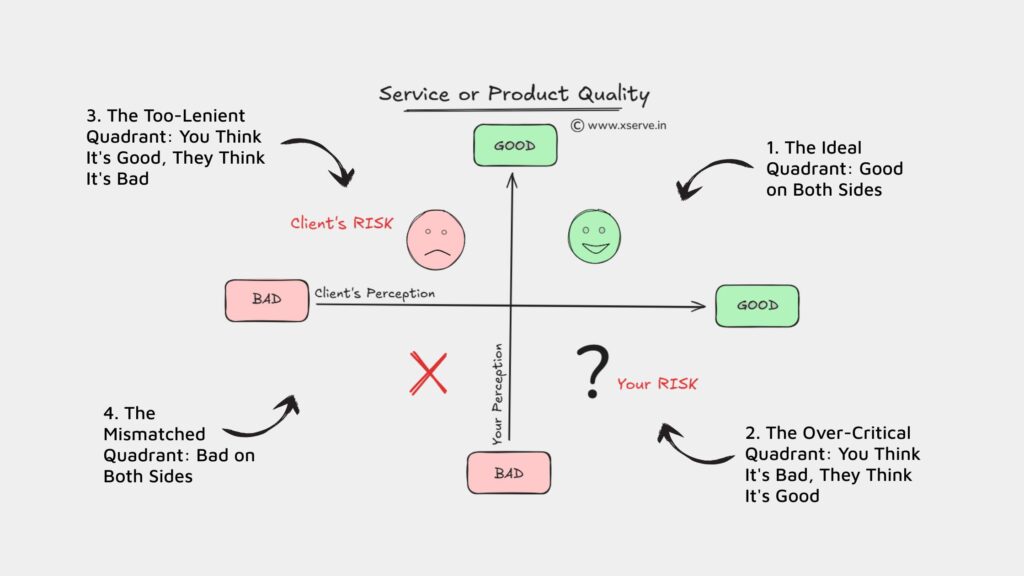
1. The Ideal Quadrant: Good on Both Sides
This is the goal. You believe your service is good, and your client agrees. This is the sweet spot of alignment, where trust is built, relationships flourish, and both parties benefit.
Here, your operational efficiency is high because you’re not over-engineering solutions, and your clients are happy because you’re consistently meeting their needs.
2. The Over-Critical Quadrant: You Think It’s Bad, They Think It’s Good
In this quadrant, you are a perfectionist. You may rate your service as “bad” or not good enough, even though your client is delighted.
This scenario, often referred to as Producer’s Risk, may seem harmless. After all, a happy client is a happy client, right? Not necessarily.
This gap can lead to significant operational inefficiencies.
You might spend extra time and resources on re-work, “defect” correction, or continuous improvements that your client neither requested nor noticed. This over-servicing drives up your costs, erodes your profit margins, and can lead to burnout for your team.
You are essentially creating internal problems that don’t exist externally. Don’t fix what’s not broken.
3. The Too-Lenient Quadrant: You Think It’s Good, They Think It’s Bad
This is perhaps the most dangerous quadrant. You’re confident in your service quality, but your client is disappointed.
This is the essence of Buyer’s Risk. Your internal processes and quality checks might pass a product or service you believe is “good,” but it fails to meet your client’s expectations.
This gap has serious, long-term consequences.
A client who feels their expectations were not met is likely to churn. This can lead to negative reviews, a damaged reputation, and a loss of future business. The cost of acquiring a new client is far higher than retaining an existing one, making this a high-stakes problem that can jeopardize the very future of your business.
4. The Mismatched Quadrant: Bad on Both Sides
This is the failure state. Neither you nor your client are happy with the quality of the service.
This indicates a fundamental breakdown in your processes, your understanding of the client’s needs, or both. If you find yourself here, it’s not just a concern. It’s a sign that immediate and drastic changes are required to save the relationship and your reputation.
Bridging the Perception Gap
So, how do you move towards that ideal top-right quadrant?
The answer lies in constant feedback and calibration.
- Implement a Feedback Loop: Go beyond formal surveys. Create a culture where feedback is a continuous dialogue. This means regular check-ins, asking open-ended questions, and truly listening to your clients’ needs and concerns.
- Establish a Shared Definition of “Good”: Before a project begins, align with your client on what success looks like. Define the parameters of quality together. What are their key performance indicators? What do they value most?
- Encourage Transparency: Be open about your process and what you’re delivering. Don’t wait for a problem to arise. Proactively share progress and solicit feedback along the way.
- Measure the Intangibles Intentionally: While satisfaction and happiness aren’t quantifiable like revenue, you can still measure them. Use tools like Net Promoter Score (NPS), Customer Satisfaction (CSAT) scores, and qualitative interviews to get a clearer picture of client sentiment.
The perception of quality is a powerful force that can either build or break your business.
By actively working to align your perception with that of your clients, you not only mitigate risk but also forge stronger, more resilient partnerships.
For over a decade, I’ve partnered with ambitious business owners to transform challenges into opportunities. Message me or connect with me on LinkedIn if you’d like to talk about your business goals and challenges. Thank you!